← Back/Work / Work experience / Research
DEVOL and BMI OrganBank
Undergraduate Research Intern, Organ perfusion, Duke Surgery, Feb 2026 to present
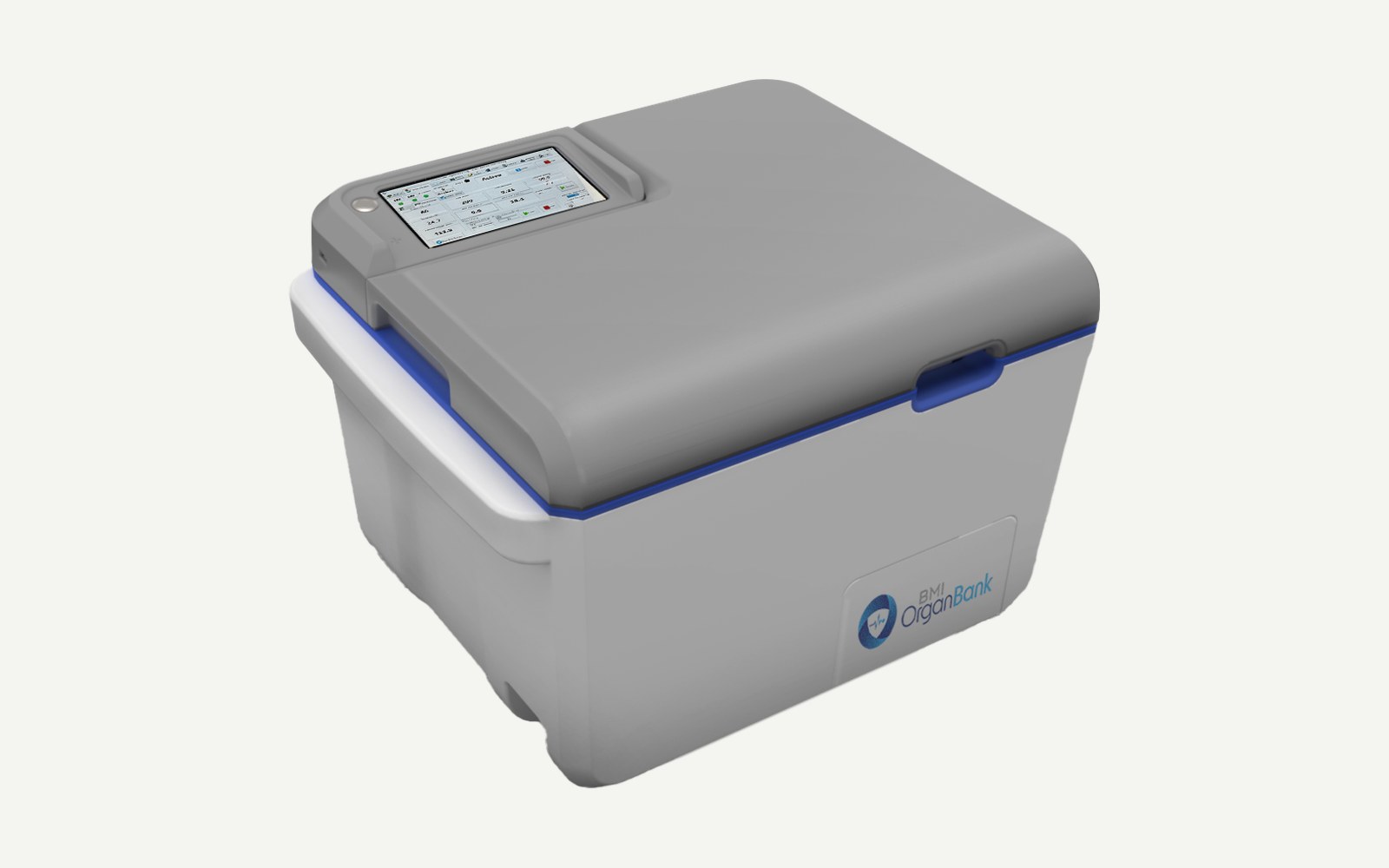
BMI OrganBank Kidney transport device. Company imagery.
| Role | Undergraduate Research Intern |
|---|---|
| Context | Organ perfusion, Duke Surgery |
| Dates | Feb 2026 to present |
| Field | Organ Perfusion, Transplant Medicine, MedTech |
| Skills | Patent Pending, Embedded Systems, CAD, Circuit Design, Clinical Collaboration, 3D Printing, Test Planning, Regulatory Awareness, Technical Writing |
The problem
Nearly 100,000 Americans are waiting for a kidney transplant. Thousands of recovered kidneys go unused every year because surgeons make high-stakes decisions with limited time and limited data on viability. Cold storage, the standard of care, pauses metabolism and offers a narrow window and little physiologic insight. Normothermic alternatives need donor blood and add cost and complexity.
BMI OrganBank, the commercial spin-out of the Duke Ex-Vivo Organ Laboratory (DEVOL), is building a room-temperature, bloodless preservation platform. In company-reported pre-clinical results, kidneys stayed viable for up to 72 hours with 0% delayed graft function, against 40% under standard hypothermic preservation. Published preclinical data so far describes 24-hour preservation, so treat the 72-hour figure as the company’s own claim.
What I built
Autonomous dialysis circuit
- Designed a new addition to the lab’s automated dialysis circuit for ex vivo perfusion, removing a manual intervention step during multi-hour runs
- Built for dual use: BMI OrganBank’s commercial products and future NIH-funded research platforms
- Led the arc from first prototype and component design through iteration, order sheets, and handoff to outside engineers for final implementation
Engineering stack
- Led CAD, circuitry design, and embedded programming for closed-loop control
- Worked on perfusion methods aimed at better viability metrics under physiologically accurate conditions
- Collaborated directly with transplant surgeons, clinical researchers, and engineers across DEVOL and BMI OrganBank
IP, clinical exposure, and regulatory context
- The circuit addition I designed went through Duke’s invention disclosure process and is now in patent application and review
- Observed live porcine surgeries and the testing of the original system. My parts are slated for upcoming test runs
- Built working knowledge of FDA device development frameworks as they apply to organ preservation
- Participated in organ failure simulation work on a path toward live organ studies and animal model validation
- The work may feed a future NIH grant application. I have not written grant material yet, so I do not claim it
Company context
The lab’s work sits inside a roughly $3.5M NIH-funded research program. BMI OrganBank licensed the perfusion technology from Duke, holds FDA Breakthrough Device Designation (2025) for its portable kidney preservation device, and has raised outside capital from the National Kidney Foundation Innovation Fund and angel groups including TCA Venture Group and Golden Seeds, with an earlier Small Business Research Loan from the North Carolina Biotechnology Center. It received the Angel Capital Association’s Luis Villalobos Award in Life Sciences in 2026. All of this comes from public announcements, none of it from inside the company.